Black bear captured, tagged and re-released in county over weekend
PROTECTED CONTENT
If you’re a current subscriber, log in below. If you would like to subscribe, please click the subscribe tab above.
Username and Password Help
Please enter your email and we will send you a password reset link.
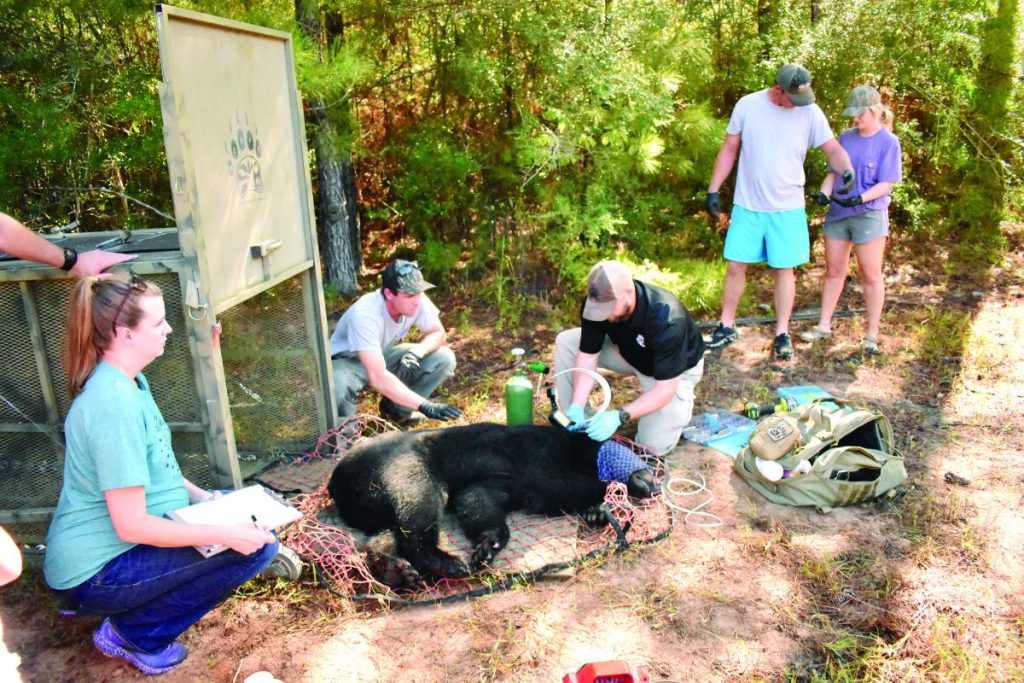
Meagan Davis is shown (Above, left) jotting down information as Greene County resident Tristan Reynolds (Center) monitors Bear M51’s breathing while Mississippi Black Bear Program Director Anthony Ballard adjusts the fitting for a tracking collar. Also shown are Hollie Williams and Will Harvison, who also helped monitor the bear during the process.
Photo by RUSSELL TURNER | Herald Editor
By RUSSELL TURNER
Herald Editor
The Black bear population in Mississippi is growing and so are bear sightings around the state.
Sightings in Greene County are growing too, but have been limited mostly to images caught on game cameras or animals encountered by motorists along local roadways. But, this past weekend provided the best evidence to date that bears are returning to the area as a young bear was captured and later released at the same spot on a 400-acre tract of private land in the Gatlin Creek area.
The bear, believed to be approximately three years old, was captured and re-released on land owned by Ransom Jones, who has been seeing evidence of bears on the property since he purchased it 25 years ago. Jones even making some plaster molds of assorted paw prints during his first few years living on the property. He and family members have spotted a few bears and once had one come into the Jones’ yard to take advantage of food in bird and game feeders. But, it was only recently that his grandson Tristan Reynolds, who lives adjacent to the property and helps his grandfather maintain it.
“Tristan is an avid hunter and has game cameras all over the property,” Jones said. “He is the one that got photos and video evidence of the bear and reached out to wildlife officials.”
Soon, Reynolds was in contact with Anthony Ballard, the Black Bear Program Leader for the Mississippi Department of Wildlife Fisheries and Parks (MDWFP). After a few conversations and sharing of images from the game cameras, Ballard asked for permission to try to trap the bear for research purposes. Reynolds and Jones were all-in for the idea.
“I contacted the Black Bear Program after following a Facebook page called Mississippi Black Bears,’ Reynolds told the Herald. “Anthony Ballard was the administrator for that page and actively posted on the page bears they had trapped. I was super curious on how old our bear was.”
“We’ve had bears on the property for years, but have never seen one collared for tracking.”
Ballard brought a specialized bear trap to Greene County and set it up last Monday (Sept. 30). Once in place and baited, it took a couple of days for the bear to start checking it out. Ballard monitored the trap remotely via its on-board cameras. He is also able to activate the trap remotely, and did so Saturday morning around 6 a.m. when he knew he could make his way from his home near Jackson to Gatlin Creek and limit the stress on the animal.
“We have very little data on bears in this area of the state, so I was excited to hear from Tristan,” Ballard said.
Ballard was on site at Jones’ residence by 9 a.m. Saturday morning and was met by Reynolds, Jones, a small group of family members (including several youngsters) and two journalists. After a quick review of what to expect and how to act near the trap, Ballard made his way to the trap and sedated the bear with a dart gun. A short time later, the group made its way to the trap.
With the assistance of volunteers from the group pulled the bear from the trap and began a full work-up on the animal.
Ballard and volunteers moved quickly. Hollie Williams, a trained nurse, Reynolds, Will Harvison and Josh Davis, monitored the bear’s vitals, checking its temperature, heart-rate and breathing. They supplemented the bear with additional oxygen, poured water on its paws and coat and set up a battery-powered fan to keep it cool.
The team fitted the bear with a GPS collar, took measurements, as well as hair, blood and other tissue samples for DNA and other testing. Ballard also implanted a microchip under the skin of the bear, similar to that used with pets, so that researches could scan and identify the bear if captured or found in the future, even if the tracking collar and ear tags are gone. All the while, volunteer Meagan Davis made notes of every detail.
“We take a lot of care to monitor the animal and to limit the stress we put on it throughout the process,” Ballard said. “We get a lot of information from the hair, blood and tissue samples.”
“After the bears are released, we get a lot of information from the collars, such as its home range and insight into the bears’ habitat selection – things in the daily life of a bear are recorded.”
Ballard said that once enough of that information is gathered and how home ranges for individual bears might overlap, then researches can start piecing together population projections based on the way they’re using certain landscapes and habitat.
The Gatlin Creek bear, now officially known as M51, weighed in a 177 pounds and was 26 inches tall at the front shoulder when walking on all-fours. He was just over five feet long from snout to tail and had a front paw that was four inches wide, with a rear paw measuring just over three inches across.
After roughly an hour, an antidote to the sedation was given, and within a few minutes M51 awoke and fled quickly into the thicket behind the clearing where the trap was located. MDWFP generally does not relocate bears, but instead releases them in the same locations where they are trapped, checked out and collared.
“It was a cool experience for us,” Reynolds said. “It is something all of us, especially the kids, will remember for a long time.”
Along with enjoying the experience, Reynolds said he is hopeful the family’s actions will help with the ongoing conservation efforts for bears in Mississippi.
“What I hope people take from this is that landowners and land lessors would be more open to allowing the MDWPF do their jobs,” Reynolds noted. “The Mississippi Black Bear is now protected. Surrounding states have opened a bear season, and it would be nice to be able to hunt these animals again one day. It all starts with the landowners allowing these guys to do their job to help the population flourish.”
On Tuesday, Reynolds shared images and video he had captured early that morning of M51 appearing healthy and unphased by his Saturday experience.
Mississippi Bear Project is making a difference
Mississippi has two species of black bears – the American Black Bear (Ursus americanus) is found in the northern third of the state, while the Louisiana Black Bear (Ursus americanus luteolus) is found in the southern two-thirds of the state. The species are very similar and practically indistinguishable to the naked eye. Both are classified as ‘endangered species’ under Mississippi law.
According to the Mississippi Black Bear Project, black bears have played a substantial role in the heritage and history of Mississippi as Native Americans used the black bear as a source of food, clothing and goods for trade with European travelers.
The vast acreages of bottomland hardwood forests and impenetrable canebrakes in parts of the state were home to high densities of black bears at the turn of the century. But, by the early 1900s, bear numbers saw a sharp decline due to overhunting and habitat destruction and fragmentation. They were nearly completely eliminated from the Mississippi landscape with fewer than a dozen individuals remaining at one point.
The MDWFP Black Bear Program got its start in 2002 with a focus on conducting research on the animals. At that time, only 50 bears were thought to be residing in the state.
Ballard is the Bear Program Director and Saturday’s activities were Ballard’s 50th workup of a captured bear. He and Bear Project team members also do “den checks,” evaluating female black bears’ reproductive success and health in the early spring.
“We’re hoping that the black bear continues along the trajectory that so many other wildlife species have, from a small population to now something that’s ubiquitous and a well-accepted game species,” Ballard said.
At the time of the program’s inception in 2002, less than 50 bears were known to be in the state. Ballard says the state’s bear population appears to be growing steadily and that a new population estimate is expected to be out in the next year.
Bear reintroduction efforts have been successful in Louisiana and Arkansas, which has helped Mississippi’s population as black bears have migrated to the state. Male bears are known to travel further distances than female bears and Mississippians have been seeing them for decades. Female sightings and encounters in the state have been less common, but Ballard says an increase in the number of reproducing female bears, as seen in den checks, could mean future population growth for the bears.
“The story that I try to tell is that this of a native wildlife species that was at the brink of extinction, that used to be an important game species back in the early 1800s and 1900s,” Ballard said in a recent interview. “What we would like to see as an agency is for that species to come back in healthier numbers where they can support a hunting season, and the residents of Mississippi can enjoy that resource again, just like they did back in the days of Teddy Roosevelt.”
That notion excites some residents and troubles others, which is why another component of the MDWFP Black Bear Program is public outreach, which Ballard says is an effort to help residents get ready for the growing number of black bears in their areas around the state.
Ballard knows that as the bear population grows in Mississippi, interactions between people and bears will grow as well.
“We want to make sure that’s smooth and that people are educated on the front end about how to live with bears and how to deal with bears,” Ballard said. “We want to help people develop a baseline understanding of how to avoid conflict with bears.”
Ballard pointed to practices such as putting pet food up and taking garbage cans out on the morning of collection instead of the night before as small practices people can implement into their daily routines that can help prevent a potential conflict whenever residents do have bears in their areas.
“You want to minimize the exposure to an attractant,” Ballard added. “Bears have an incredible sense of smell, roughly seven times better than a dog. So, anything a dog will get into, a bear will get into, and he’s even better at it.”
Game feeders, and even barbecue grills can also attract bears, but Ballard noted that confrontations with black bears are extremely rare.
Ballard said that when residents do encounter a bear, they just let the bear go on about its business.
“A lot of times the bear will see or smell you and be gone before you even know its there,” Ballard added. “People who find themselves in a situation where the bear gets a little too close for comfort, then it’s time to get big and loud and scare it away.”
“If you’re worried about it, bear spray is a good thing to keep on hand. It is safe for the bears and it’s very effective because their noses are very sensitive.”
Mississippi State University and MDWFP are looking for properties in southeast Mississippi, like the Jones tract, to trap and collar bears. Any residents who regularly see bears on their property and would like to help, should contact MDWFP through the MDWFP Black Bear Program website at www.mdwfp.com/ wildlife-hunting/wildlife-species-program/black-bear-program. More information about the Black Bear Program can also be found on the website or by calling (601)432-2242. Residents can also follow the MDWFP Facebook page at facebook.com/mdwfp.
“We are excited to see the black bear population growing in Mississippi and appreciate the public’s active response. Our work relies heavily on the cooperation of landowners across the state who allow us access to their property for research. I am proud with the direction this program is going.” said Anthony Ballard, MDWFP Bear Program Coordinator.
Related Posts